
The short version
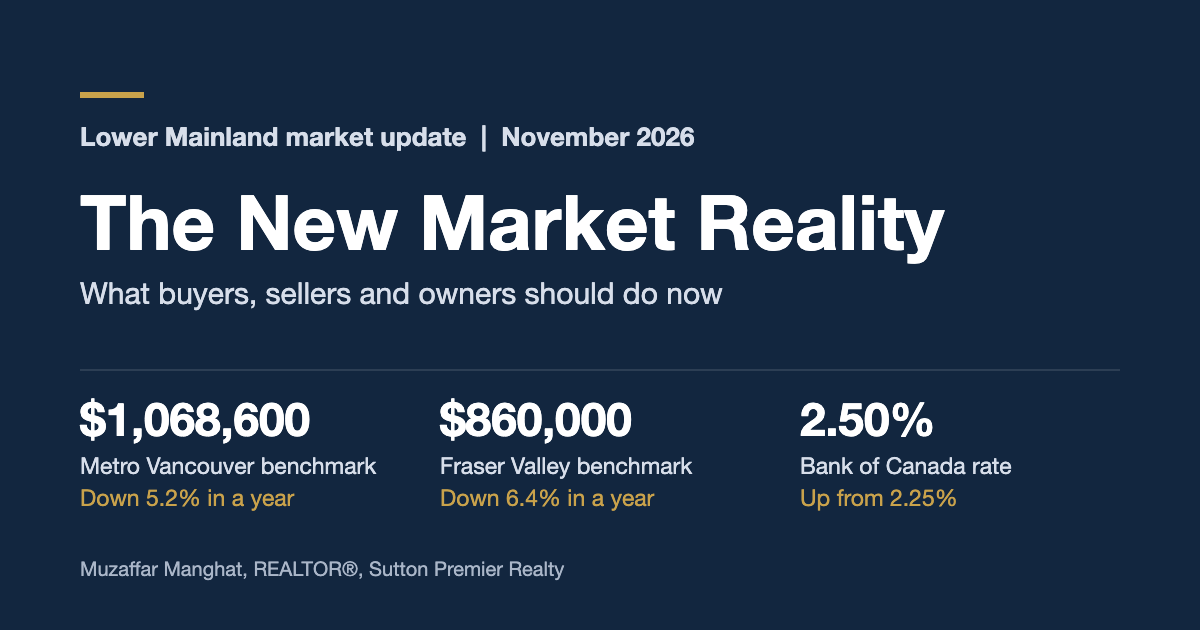
The Lower Mainland market has reset. Prices are down from a year ago, borrowing just got more expensive, and buyers have plenty to choose from.
After more than 20 years in real estate, my advice is simple: make decisions on today’s numbers, not on the market you remember.
- Sellers: price against what sold in the last few months, not what your home was worth last year.
- Buyers: you have room to negotiate, but get a rate hold before you shop.
- Owners renewing a mortgage: start early and compare offers before your renewal letter arrives.
The October numbers
Both real estate boards reported fewer sales and lower prices than a year ago. Surrey, Langley, White Rock, North Delta, Abbotsford and Mission are in the Fraser Valley numbers. Burnaby, Coquitlam, Richmond, Vancouver and the North Shore are in the Metro Vancouver numbers.
| October 2026 | Metro Vancouver | Fraser Valley |
|---|---|---|
| Home sales | 2,024 | 1,051 |
| Sales vs. October 2025 | Down 10.2% | Down 6% |
| Composite benchmark price | $1,068,600 | $860,000 |
| Benchmark vs. October 2025 | Down 5.2% | Down 6.4% |
| Active listings | 15,688 | 9,164 |
| Listings vs. October 2025 | Down 4.3% | Down 10% |
| Sales-to-active ratio | 13.4% | 11% |
A ratio under 12% is a buyer’s market, and 12% to 20% is balanced. The Fraser Valley is firmly in buyer’s territory. Metro Vancouver is just above the line, but its detached homes sit below it at 11.6%.
| Home type | Metro Vancouver benchmark | 1-year change | Fraser Valley benchmark | 1-year change | Fraser Valley days to sell |
|---|---|---|---|---|---|
| Detached | $1,775,200 | Down 7% | $1,293,800 | Down 8.5% | 50 |
| Townhome | $1,006,500 | Down 5.5% | $742,300 | Down 5.5% | 37 |
| Apartment | $673,400 | Down 5.9% | $460,800 | Down 8.1% | 44 |
A benchmark is the estimated price of a typical home, not an average of what sold.
What has changed
Prices have given back much of the run-up. In June, the Fraser Valley Real Estate Board put prices 26% below their 2022 peak. The Fraser Valley benchmark has dropped about 3% since then. The board’s CEO says affordability is at its best level in five years.
Rates have turned. On October 28, the Bank of Canada raised its policy rate from 2.25% to 2.50%, its first increase since July 2023. Inflation reached 3.1% in September, and the Bank expects 3.5% by year-end. That day, the lowest 5-year fixed rate on Ratehub was 4.34%. The lowest variable rate was moving from 3.45% to 3.70%.
Supply is high, but it has stopped climbing. Metro Vancouver’s listings are still 24% above the 10-year average, yet they are lower than a year ago. Sellers are stepping back too, with new listings down 11.6% in Metro Vancouver. Monthly price moves were small in October: down 0.7% in Metro Vancouver and 0.1% in the Fraser Valley.
The market has split by home type. Detached homes led Fraser Valley sales in October. The board says the price correction appears to be bringing them within reach of more buyers. Metro Vancouver apartment sales fell 16.7% from last year, while attached sales fell just 1.9%. New condos are the weakest spot. Rennie counted more than 14,000 unsold new condos in Metro Vancouver at the end of June, at all stages of construction. Only 1,340 new condos sold in the first half of 2026, a record low.
Housing rules may change. The BC Conservatives won a majority on October 24. Premier-designate Lorne Doerkson has said he will remove municipal housing targets and, at minimum, amend the small-scale multi-unit rules in Bill 44. The BC Real Estate Association has asked for careful consultation before any repeal. Nothing has passed yet, so today’s rules still apply.
If you’re selling
- Price to recent sales. Buyers will compare your home with what sold in the last few months and with everything else listed. Last year’s value doesn’t count.
- Plan for more time. The average Fraser Valley detached home took 50 days to sell in October, up from 37 days in June. Build that into your moving plans.
- Make the first impression count. With 9,164 active listings in the Fraser Valley, buyers can skip homes that look tired or overpriced. Handle small repairs before the photos are taken.
- Moving up? Look at the gap, not just your price. Over the past year, the Fraser Valley detached benchmark fell about $120,000 and the townhome benchmark fell about $43,000. The step from a typical townhome to a typical detached home now costs about $75,000 less. You may sell for less and still come out ahead.
If you’re buying
- Get a rate hold first. A pre-approval tells you what you can spend, and a rate hold protects you if rates rise while you shop.
- Run the payment, not just the price. Lower prices help, but higher rates can take that back. The example below shows how the two trade off.
- Use your leverage, where you have it. In a buyer’s market, you can ask for inspection and financing conditions and take your time with strata documents. Leverage varies, though. Metro Vancouver attached homes have a 16.5% sales-to-active ratio, which is balanced.
- Buying a new condo? With this much unsold inventory, ask what incentives are on offer and compare the full cost with resale. Have a lawyer review any presale contract.
Payment example: a Fraser Valley townhome at the $742,300 benchmark, with 20% down and a 25-year amortization, at an illustrative 4.50% rate.
| Scenario | Monthly payment |
|---|---|
| Today’s price at 4.50% | About $3,287 |
| Year-ago price at 4.50% | About $3,478 |
| Today’s price at 4.75% | About $3,370 |
The past year’s price drop saves about $191 a month. A rate of about 5.08% would cancel that out. Your own rate will depend on your lender and down payment.
If you own and your mortgage is renewing
- Start early. Talk to your lender or a broker, compare offers, and know your new payment before the renewal notice arrives.
- On a variable rate? Each quarter-point adds about $14 a month for every $100,000 owing over 25 years. Check how your lender applies it, because some keep the payment the same and put less toward principal.
- Planning a suite or multiplex? Bill 44 is still in place, but the new government intends to change it. Check with your city before you spend money on plans.
- Worried about the new payment? Run the numbers now. You have more options, including selling on your own timeline, when you start early.
What to watch next
I wouldn’t plan around a quick rebound. The Bank of Canada calls its housing outlook “subdued.” The BC Real Estate Association expects BC sales to rise 7.5% in 2027, with a slow recovery, but that August forecast came before the rate increase.
| When | What | Why it matters |
|---|---|---|
| December 9, 2026 | Next Bank of Canada rate decision | Markets see a slight chance of another increase. TD and CIBC expect 2.75% early in 2027. |
| January 1, 2027 | Federal foreign buyer ban is set to expire | Ottawa says it is reviewing all options. |
| No date yet | BC housing legislation | Changes could affect multiplex rules and where density goes. |
Let’s look at your numbers
These are regional figures, and every street and strata is different. If you want a straight read on what your home would sell for or what your budget buys today, call or text me at 604-785-5555, or send me a message.
You can also read how I work with sellers and buyers.
Muzaffar Manghat, REALTOR®, Sutton Premier Realty
Sources
- Fraser Valley Real Estate Board, October 2026 release
- Greater Vancouver REALTORS®, October 2026 report
- Fraser Valley Real Estate Board, June 2026 release
- The Canadian Press on the Bank of Canada’s housing outlook
- Ratehub on the October rate increase
- Canadian Mortgage Professional on economists’ rate forecasts
- Daily Hive on proposed BC housing changes
- CTV News on the BC Real Estate Association’s response
- Daily Hive on unsold new condos
- Global News on the foreign buyer ban
- BC Real Estate Association, third-quarter 2026 forecast
This article is general information, not financial, mortgage or legal advice. Payment examples are estimates. Statistics are from the boards named above and are believed reliable but not guaranteed. This is not intended to solicit buyers or sellers currently under contract with a brokerage.

